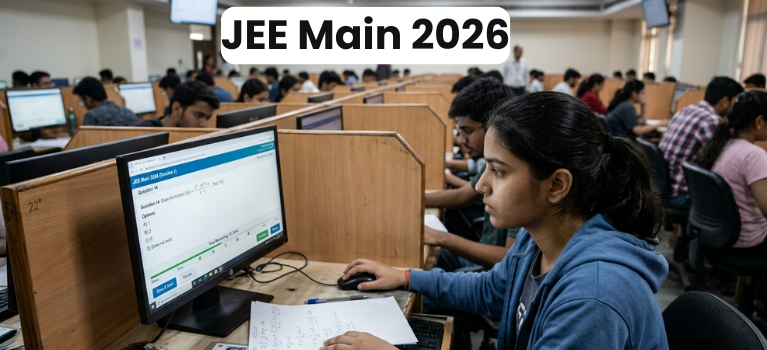
JEE Mains 2026 – The National Testing Agency has released the JEE Main 2026 Session 2 results (Session 2) on the official website, bringing the examination cycle to a crucial stage for aspirants nationwide. Earlier, the Session 1 (January session) results were also declared following exams held from January 21 to January 30, 2026, enabling students to assess their performance and plan their next steps.
Candidates are advised to download and retain their scorecards for use during counselling and admission processes. Looking ahead, students should stay updated with further announcements regarding cut-offs, ranks, and JoSAA counselling schedules, which will play a key role in the admission process to premier engineering institutes.
Latest Update – CLICK HERE to check your JEE Main 2026 Results Session 2.
JEE Main 2026 – Important Dates and Events
The NTA has officially announced the dates and details of the JEE Main 2026 events. Students can refer to the table below for the dates:-
JEE Main Exam Dates 2026
|
JEE Mains – 2026 Session 1 (January 2026) |
|
| Events | Dates |
| Online Submission of Application Form | CLOSED |
| Last date for successful transaction of prescribed Application Fee | CLOSED |
| Correction in Particulars of the Online Application Form | CLOSED |
| City Intimation Slip | First week of January 2026 |
| Downloading Admit Cards from the NTA website | 03-04 days before the date of the Examination |
| Dates of Examination | Between January 21 to January 30, 2026 |
| Display of Question Paper attempted by the Candidate and Answer Keys for inviting challenges | Will be displayed on the NTA website |
| Declaration of Result | By February 12, 2026 |
|
JEE Mains – 2026 Session 2 (April 2026) |
|
| Online Submission of Application Form | February 1 to 25, 2026 |
| Last date for successful transaction of prescribed Application Fee | March 13, 2026 by 11:50 PM |
| Correction in Particulars of the online Application Form | February 27 and 28, 2026 |
| City Intimation Slip | March 21, 2026 |
| Downloading Admit Cards from the NTA website | Beginning March 29, 2026 |
| Dates of Examination | Between April 02 and April 08, 2026 |
| Display of Question Paper attempted by the Candidate and Answer Keys for inviting challenges | April 11, 12, and 13, 2026 |
| Declaration of Result | By April 21, 2026 |
JEE Main Highlights 2026
Here’s a quick JEE Mains 2026 highlight section –
JEE Main Key Highlights 2026
| Name of Examination | Joint Entrance Examination (JEE) Main 2026 |
| Exam Conducting Body | National Testing Agency (NTA) |
| JEE Main Official Website | jeemain.nta.nic.in |
| Exam Frequency | Twice a Year |
| JEE Main Exam Date | January 21 to January 30 2026 (Session 1)
April 02 to April 08 2026 (Session 2) |
| Mode of Exam | Online (computer-based test) |
| Credentials required to download JEE Main Admit Card | JEE Main application number and Students’ Date of Birth (DoB) |
| Compulsory documents to carry on exam day | JEE Main Admit Card
Valid original photo ID (like Aadhaar, Voter ID, Passport, PAN Card/ Driving License/ Ration Card/ School Identity Card) |
| JEE Main Papers | Paper 1 – BE/BTech
Paper 2A – BArch Paper 2B – BPlan |
| Duration of JEE Main Exam | 3 hours or 3 hours 30 minutes (4 hours for Persons with Benchmark Disabilities) |
| Number of questions | BE/BTech – 90 MCQs (Candidates need to answer just 75 questions)
BArch – Online and Offline (Drawing Test) – 77 questions BPlan – 100 MCQs |
| Maximum Marks | BE/BTech – 300 marks
BArch – 400 marks BPlan – 400 marks |
| Marking System | JEE Main – 4 marks per correct answer
B. Arch paper – 2 questions of 50 marks each |
| Negative Marking | For MCQs: (-1) mark per incorrect answer
For Non-MCQs: No negative marking |
Score Card for JEE(Main)-2026 [Session-II] Paper-1(B.E. / B.Tech)
JEE Main Exam Schedule 2026
Candidates can find the particulars of the exam schedule/timing in the table below:
|
Timing of Examination |
Duration of Examination | First Shift |
Second Shift |
| Paper 1, 2A, 2B | 3 Hours | 09:00 AM to 12:00 Noon (IST) | 03:00 PM to 06:00 PM (IST) |
| Paper 2A & 2B | 3 Hours 30 Minutes | 09:00 AM to 12:30 PM (IST) | 03:00 PM to 06:30 PM (IST) |
Pre-Examination Activities:
|
Activity |
Timing |
| Entry, Frisking, Biometric Registration, Document Verification, etc. | 07:00 AM to 08:30 AM / 01:00 PM to 02:30 PM |
| Instructions by Invigilator(s) | 08:30 AM to 08:50 AM / 02:30 PM to 02:50 PM |
| Candidate Login to Read Instructions | 08:50 AM / 02:50 PM |
JEE Main Eligibility Criteria 2026
Candidates who wish to apply for JEE Main 2026 must have passed Class 12 from a recognised school board in 2023/2024 or must be taking their Class 12 final exams in 2026. There are 8 factors related to the JEE Main eligibility criteria 2026:
- Nationality
- Age
- Number of Attempts in JEE Main
- Marks Required in Class 12(Qualifying Examination
- List of Qualifying Examinations (QE) for Class 12
- Year of Appearance in Qualifying Examination (Class 12)
- State of Eligibility
- Reservations
Nationality
- As per JEE Main eligibility criteria, a candidate should be an Indian citizen (according to the Indian Citizenship Act, 1955).
- Candidates belonging to the category of Non-Residential Indian (NRI) or Persons of Indian Origin (PIO) or Overseas Citizen of India (OCI) can also apply for JEE Main 2026, provided they have the category certificates at all stages of JEE Main.
Age Criteria
- There is no upper age limit to appear for the JEE Main. However, candidates may be required to fulfil the age criteria of the institute/s where they wish to take admission
- The birth date given in the Secondary Education Board/University Certificate will be considered.
Number of Attempts in JEE Main
- According to NTA officials, a maximum of 4 attempts are allowed for the JEE Main exam
- To avail admission in colleges across Odisha, Nagaland, Madhya Pradesh and Gujarat, the age limit and the number of attempts for JEE Main will be similar to the previous practices of their respective state-level examinations.
Marks Required in Class 12 (Qualifying Examination)
- For taking up JEE Main, there is no such requirement of the minimum marks in Class 12.
- For admission to NITs/IIITs/GFTIS, a minimum of 75% marks in Class 12th are mandatory.
List of Qualifying Examinations
- Final examination of the 10+2 system, conducted by any recognised Central/ State Board, such as Central Board of Secondary Education, New Delhi; Council for the Indian School Certificate Examinations, New Delhi; etc.
- Intermediate or two-year Pre-University examination conducted by a recognised Board/
University. - A Diploma recognized by AICTE or a state board of technical education (at least 3 years’ duration)
- Any Public School/ Board/ University examination in India or any foreign country recognised as equivalent to the 10+2 system by the Association of Indian Universities (AIU)
- Final examination of the two-year course of the Joint Services Wing of the National Defence Academy
- Higher Secondary Certificate – Vocational Examination
- Senior Secondary School Examination conducted by the National Institute of Open Schooling with a minimum of five subjects
- Intermediate or two-year Pre-University examination conducted by a recognized Board/ University
- General Certificate Education (GCE) examination (London/Cambridge/Sri Lanka) at the Advanced (A) level
- High School Certificate Examination of the Cambridge University or International Baccalaureate Diploma of the International Baccalaureate Office, Geneva.
Candidates who have completed the Class 12 or equivalent examination outside India or from a Board not specified above should produce a certificate from the Association of Indian Universities (AIU) to the effect that the examination they have passed is equivalent to the Class 12 Examination.
In case the Class 12 examination is not a public examination, the candidate must have passed at least one public (Board or Pre-University) examination earlier.
Year of Appearance in Qualifying Examination (Class 12)
- Candidates who have passed the Class 12/equivalent examination in 2023/2024/2025
JEE Main State of Eligibility
State code of eligibility means the code of the state from where the candidate has passed Class 12 or equivalent examination because of which the candidate becomes eligible to appear in JEE Main.
- Candidates must note that the State code of eligibility does NOT depend upon the native place or the place of residence of the candidate. For example, if a candidate appears for the Class 12 examination in New Delhi and is a resident of Greater Noida, Uttar Pradesh, the candidate’s State code of eligibility will be that of Delhi and NOT that of UP.
- If a candidate has passed Class 12 or equivalent qualifying exam from one state but appeared for improvement from another, the candidate’s state code of eligibility will be from where the candidate has first passed the Class 12 and NOT the state from where the candidate has appeared for improvement.
- Candidates passed/appearing in Class 12 from NIOS should select the State of Eligibility according to the state in which the study centre is located.
- For Indian nationals passing the Class 12 or equivalent exam from Nepal or Bhutan, the state code of eligibility will be determined based on the permanent address of the candidate in India as given in the passport.
- The State code of eligibility for OCI/PIO passing the Class 12 examination in India is at par with Indian nationals. But, OCI/PIO passing the Class 12 exam from an institution abroad are eligible for Other State quota seats or All India Quota seats (but NOT for Home State quota seats) in all NITs, IIEST and Other-CFTIs.
Reservations
- In the case of the institutes run or aided or recognised by State Governments, the reservation policy of the respective State Governments will become applicable.
- In the case of Central Government-run institutes, the reservation would be applicable as mentioned below:
- General Economically Weaker Section (GEN-EWS): 10% of seats in every course are reserved for this category. Only General category candidates who meet the conditions specified in OM No. 20013/01/2018-BC-II dated January 17, 2019, issued by the Ministry of Social Justice and Empowerment, will be eligible for reservation benefits. The criteria for GEN-EWS will follow the prevailing norms and/or notifications of the Government of India.
- Other Backward Classes – Non-Creamy Layer (OBC-NCL): 27% of seats are reserved for this category. Eligibility for OBC-NCL:
-
- Candidates must be listed in the current, updated central list of OBCs (http://www.ncbc.ac.in).
- OBCs present in the State list but not covered in the central list are not eligible for reservation.
- The criteria for OBC-NCL will be as per the Government of India notification.
- Candidates belonging to the creamy layer of OBC are not entitled to reservation and will be considered under the general (GEN) category.
-
-
Scheduled Caste (SC): 15% of seats are reserved for this category.
-
Scheduled Tribe (ST): 7.5% of seats are reserved for this category.
-
Persons with Disability/ Persons with Benchmark Disability (PwD/PwBD): 5% of seats are reserved within each category (GEN, GEN-EWS, OBC-NCL, SC, and ST).
JEE Main Application Form 2026
The application window for the second session of JEE Mains will open in the last week of January. Candidates who miss the deadline will need to pay a late fee along with the regular application fee.
Steps to fill JEE Main Application Form
- Visit the official website jeemain.nta.ac.in
- Click on the “Registration” tab
- Create a new registration
- Enter the required particulars like email ID, name, phone number
- Fill in the educational details and upload the required documents
- Pay the application fee and submit the application
- Take a printout of the application form for your future reference
JEE Main Admit Card 2026
Registered candidates, whose applications are accepted by the NTA, can download their JEE Main admit card by entering their particulars at jeemain.nta.ac.in.
Follow the steps below to learn about the JEE Main admit card download process:
- Visit the official website of JEE Main
- Click on the admit card link
- Click on the ‘Through application number and password’ link
- The page will redirect you to the login page
- Enter your application number and password
- Click on ‘Sign in’
- When the admit card appears on the screen, download it and take a printout for future references
Note:- The admit card will have four pages where the first page shall consist of a declaration, which the candidate must sign on the exam day.
Explore Scholarships for Graduation Students
JEE Main Fee Structure 2026
The table below provides a clear breakdown of the fee structure for the JEE Main exam. Processing charges and Goods and Services Tax (GST) are to be paid by the candidate, as applicable. Payments can be made through Credit Card, Debit Card (except Master/Visa Card), Net Banking, or UPI.
| Paper 1: B.E./B. Tech OR Paper 2A: B. Arch OR Paper 2B: B. Planning | ||
| Type of Candidate | Centres in India (₹) |
Centres Outside India (₹)
|
| General Male | 1,000 | 5,000 |
| General Female | 800 | 4,000 |
| Gen-EWS/ OBC (NCL) Male | 900 | 4,500 |
| Gen-EWS/ OBC (NCL) Female | 800 | 4,000 |
| SC/ST/ PwD/ PwBD Male | 500 | 2,500 |
| SC/ST/ PwD/ PwBD Female | 500 | 2,500 |
| Third Gender | 500 | 3,000 |
| Paper 1: B.E./ B. Tech & Paper 2A: B. Arch OR Paper 1: B.E./B. Tech & Paper 2B: B. Planning OR Paper 1: B.E./B. Tech, Paper 2A: B. Arch & Paper 2B: B. Planning OR Paper 2A: B. Arch & Paper 2B: B. Planning | ||
| Type of Candidate | Centres in India (₹) |
Centres Outside India (₹)
|
| General/ Gen-EWS/ OBC (NCL) Male | 2,000 | 10,000 |
| General/ Gen-EWS/ OBC (NCL) Female | 1,600 | 8,000 |
| SC/ ST/ PwD/ PwBD Male | 1,000 | 5,000 |
| SC/ ST/ PwD/ PwBD Female | 1,000 | 5,000 |
| Third Gender | 1,000 | 5,000 |
The application window for Session 2 will reopen as detailed in the Information Bulletin and will also be notified separately through a public notice.
- The fee can only be submitted online through Net Banking, Credit Card, Debit Card, or UPI. Processing charges and applicable GST will be charged to the candidate by the concerned Bank/Payment Gateway Integrator in addition to the examination fee.
- The confirmation page of the JEE Main online application form for each session will be generated only after successful fee payment. If the confirmation page is not generated after payment, the candidate should contact the concerned bank/payment gateway to ensure successful payment or obtain a refund for duplicate/multiple payments.
JEE Main Exam Pattern 2026
The test takers must have a better grasp of the JEE Main exam pattern 2026 to be able to prepare well for it. It must be noted that as per the JEE Main exam pattern, the test takers have to answer objective-type or MCQs along with numeric-value-based questions in the JEE main paper. The table below gives a clear understanding of the JEE Main 2026 exam pattern.
JEE Main Test Pattern
| Parameters | B.E./B. Tech | B. Arch | B. Planning |
| Mode of Examination | Computer Based Test (CBT) Mode | Mathematics and Aptitude- Computer-Based Test (CBT) Mode
Drawing- Pen and paper mode |
Computer Based Test (CBT) Mode |
| Total subjects | Physics, Chemistry, and Mathematics | Mathematics, Aptitude Test, and Drawing Test | Mathematics, Aptitude Test, and Planning Based Objective Type |
| Number of questions
|
75
(25 questions from each subject)
|
77
(Mathematics- 25 Aptitude- 50 Drawing- 2) |
100
(Mathematics- 25 Aptitude- 50 Planning Based-25) |
| Type of Questions | Objective Type – Multiple Choice Questions (MCQs) and Questions for which the answer is a numerical value, with equal weightage to Mathematics, Physics and Chemistry | Objective Type – Multiple Choice Questions (MCQs) and Questions for which the answer is a numerical value +
Test drawing Aptitude questions |
Objective Type – Multiple Choice Questions (MCQs) and Questions for which the answer is a numerical value |
| Marking Scheme | For MCQs:
+4 for each correct response -1 for each incorrect response Unattempted questions will not be marked. For Non- MCQs: +4 for each correct response No negative marking for incorrect answers or unattempted questions. |
For MCQs:
+4 for each correct response -1 for each incorrect response; Unattempted questions will not be marked. For Non- MCQs: +4 for each correct response No negative marking for incorrect answers or unattempted questions For Drawing Test: 2 questions of 100 marks |
For MCQs:
+4 for each correct response -1 for each incorrect response Unattempted questions will not be marked. For Non- MCQs: +4 for each correct response -1 for each incorrect response Unattempted questions will not be marked. No negative marking for incorrect answers or unattempted questions. |
| Maximum Marks | 300 Marks | 400 Marks | 400 Marks |
JEE Main Syllabus 2026
The following tables consists of topics and concepts covered and studied in Class 11 and 12, that are asked in the JEE exam –
JEE Main Chemistry Syllabus 2026
|
Section A: Physical Chemistry |
|||||
| Unit 1: Some Basic Concepts in Chemistry | Unit 2: Atomic Structure | Unit 3: Chemical Bonding and Molecular Structure | |||
| Unit 4: Chemical Thermodynamics | Unit 5: Solutions | Unit 6: Equilibrium | |||
| Unit 7: Redox Reactions and Electrochemistry | Unit 8: Chemical Kinetics | ||||
|
Section B: Inorganic Chemistry |
|||
| Unit 9: Classification of Elements and Periodicity in Properties | Unit 10: p-Block Elements | ||
| Unit 11: d-and-f Block Elements | Unit 12: Coordination Compounds | ||
|
Section C: Organic Chemistry |
|||||||||
| Unit 13: Purification and Characterization of Organic Compounds | Unit 14: Some Basic Principles of Organic Chemistry | Unit 15: Hydrocarbons | |||||||
| Unit 16 Organic Compounds Containing Halogens | Unit 17: Organic Compounds Containing Oxygen | Unit 18: Organic Compounds Containing Nitrogen | |||||||
| Unit 19: Biomolecules | Unit 20: Principles Related to Practical Chemistry | ||||||||
JEE Mains Physics Syllabus 2026
| Section A – Theoretical Section | |||
| Unit 1: Physics and Measurement | Unit 2: Kinematics | Unit 3: Laws of Motion | Unit 4: Work, Energy, and Power |
| Unit 5: Rotational Motion | Unit 6: Gravitation | Unit 7: Properties of Solids and Liquids | Unit 8: Thermodynamics |
| Unit 9: Kinetic Theory of Gases | Unit 10: Oscillations and Waves | Unit 11: Electrostatics | Unit 12: Current Electricity |
| Unit 13: Magnetic Effects of Current and Magnetism | Unit 14: Electromagnetic Induction and Alternating Currents | Unit 15: Electromagnetic Waves | Unit 16: Optics |
| Unit 17: Dual Nature of Matter and Radiation | Unit 18: Atoms and Nuclei | Unit 19: Electronic Devices | Unit 20: Experimental Skills |
JEE Mains Mathematics Syllabus 2026
| Unit 1: Sets, Relations, and Functions | Unit 2: Complex Numbers and Quadratic Equations | Unit 3: Matrices and Determinants | Unit 4: Permutations and Combinations |
| Unit 5: Binomial Theorem and Its Simple Applications | Unit 6: Sequences and Series | Unit 7: Limit Continuity, and Differentiability | Unit 8: Integral Calculus |
| Unit 9: Differential Equations | Unit 10: Coordinate Geometry | Unit 11: Three-Dimensional Geometry | Unit 12: Vector Algebra |
| Unit 13: Statistics and Probability | Unit 14: Trigonometry | ||
JEE Mains 2026 – Recommended Books for Students
Your preparation becomes top-notch if you study from the best available resources. Thus, here comes a list of the best books for JEE Main 2026, authored by the best industry experts. Historically, even the toppers from the past years have referred to these books and cracked the national-level UG engineering entrance exam with flying colours.
JEE Mains 2026 – Books for Physics
| Books Name | Author |
| Advance physics | Nelkon and Parker |
| Aptitude test problem in physics | Krotov |
| Fundamentals of Physics | Halliday, Resnick & Walker |
| Dynamics of a Particle & of Rigid Bodies | S.L. Loney |
| Physics Volume 1 & 2 | Tipler |
| University Physics | Freedman and Young |
| Problems in Physics | A. A. Pinsky |
| Mechanics Part-1 & 2 | DC Pandey |
| Problems in General Physics | I. E. Irodov |
| Problems in Physics | V. Zubov & V. Shalnov |
| Concepts of Physics Volume I and II | H. C. Verma |
| Feynman Lectures on physics | R. P. Feynman |
| A collection of questions and problems in physics | L. A. Sena |
| Element of Dynamics part I & II | S. L. Loney |
JEE Mains 2026 – Books for Organic Chemistry
| Books Name | Author |
| Organic Chemistry | O. P. Tandon |
| Concept of Organic Chemistry | M. S. Chauhan |
| Organic Chemistry volume 1 | I. L. Finar |
| Organic Chemistry | Arihant Prakashan |
| A Guidebook to Mechanism in Organic Chemistry | Peter Sykes |
JEE Mains 2026 – Books for Physical Chemistry
| Books Name | Author |
| IIT JEE Chemistry | O. P. Agarwal |
| Numerical Chemistry | P. Bahadur |
| General Chemistry | Ebbing |
| Physical Chemistry | O. P. Tandon |
| University Chemistry | Bruce Mahan |
| Modern Approach to Chemical Calculations | RC Mukherjee |
| Physical Chemistry (For Reading Theory) | P. Bahadur |
| Physical Chemistry | P.W.Atkins |
JEE Mains 2026 – Books for Inorganic Chemistry
| Books Name | Author |
| Concise Inorganic Chemistry | J. D. Lee |
| Inorganic Chemistry | Arihant Prakashan |
| Textbook of Inorganic Chemistry for Competitions (JEE Main & Advanced) | OP Tondon |
JEE Mains 2026 – Books for Mathematics
| Books Name | Author |
| Mathematics for Class 11 & Class 12 | R. D. Sharma |
| Algebra | Arihant |
| Maths for Class 11 & Class 12 | R. S. Agarwal |
| Vector | Shanti Nayaran |
| IIT Mathematics | M. L. Khanna |
| Trigonometry | S. L. Loney |
| Problems in Calculus of One Variable | I. A. Maron |
| Geometry | Dr. Gorakh Prasad |
| Differential Calculus | Arihant |
| Integral Calculus | Arihant |
| Introduction Probability & Its Application | W. Feller |
| Higher Algebra | Barnard and Child |
| A problem book in mathematical Analysis | G. N. Berman |
| Higher Algebra 4th Edition | Hall and Knight |
| Course in Mathematics for IIT-JEE | TMH Publication |
| Calculus and Analytic Geometry | Thomas and Finney |
JEE Main Answer Key 2026
The NTA will release the JEE Main 2026 Provisional Answer Key on its website. Candidates can challenge the key within a specified timeframe by paying a fee of ₹200 per challenge. Only online challenges with justification will be considered. The NTA’s decision on challenges will be final.
The final answer key will be released, and the JEE Main 2026 results will be based on it. No grievances regarding the answer key will be entertained after the result declaration.
JEE Main 2026 – Results
The National Testing Agency (NTA) had announced the JEE Main Session 1 result on February 26, 2026, while the Session 2 result has been declared today, April 20, 2026. Candidates can check their results on the official website jeemain.nta.nic.in by entering their application number, date of birth, and security key. The online result includes subject-wise and total NTA scores, All India Rank, category rank, JEE Advanced cutoff, along with other candidate details.
Candidates must download a copy of their result and verify the details highlighted below:
- Roll Number
- Student Name
- Category
- Father’s Name
- Mother’s Name
- Subcategory
- State code of eligibility
- Marks obtained in JEE Main (Subject-wise and total)
- All India Rank
- Category Rank
- Nationality
- Cut-off score for appearing in JEE Advanced
- Instructions
Read More – JEE Main 2026 Results Released – Direct Link to Check Scorecard & More
JEE Main 2026 – FAQs
What is the result date for JEE Mains 2026?
The JEE Main 2026 Session 1 result was declared on 16 February 2026, and the Session 2 result has been declared on 20 April 2026.
How can candidates register for JEE (Main) 2026?
Instructions to apply online for JEE (Main) 2026 are available in the Information Bulletin on the NTA official website under the heading ‘Important Information and Dates at a Glance’ (Para 3). Candidates are also advised to refer to Appendix IX of the Information Bulletin, which contains a replica of the application form.
What is JEE Main 2026 official website?
Ans: The official website of NTA JEE Main 2026 is jeemain.nta.ac.in.
If a candidate did not apply for Session 1 of JEE Mains 2026, can he or she apply for Session 2?
Yes, candidates who missed filling up the Application Form for the January Session, he/she can fill up the Application Form for the April Session at the time of opening of the portal for that session.
Do candidates have to fill a separate application form for each session?
Yes, candidates have to apply separately for each session. The application window for Session 1 is currently closed. The application date for Session 2 will be announced later.
